Ever wondered how digital artists make skin textures look real? Creating top-notch images is like solving a puzzle. It’s especially hard when you aim for the high standards of companies like Daz Productions, Inc.
Unlocking the ai porn photoreal mode is key to achieving this level of detail. By tweaking certain settings, you can turn simple images into stunning, lifelike works. They capture every small detail.
This guide offers a comprehensive walkthrough to master these settings. You’ll learn how to adjust lighting and surface settings. This way, your projects will shine with top-quality visuals.
Key Takeaways
- Understand the core settings required for high-definition image generation.
- Learn how to replicate professional 3D content standards in your own work.
- Discover techniques to enhance skin detail for a more natural appearance.
- Master the lighting configurations that bring depth to your digital scenes.
- Gain confidence in using the ai porn photoreal mode for consistent results.
Mastering the ai porn photoreal mode
Mastering the ai porn photoreal mode is not just luck. It’s about knowing how your tools work. When you understand how these systems process data, you can predict results better. This skill lets you create images that look incredibly real.
Understanding the core architecture of photorealism
Photorealism uses complex neural networks to learn from millions of images. These networks study light, shadow, and skin texture to create digital humans. Knowing this process helps you see why some prompts work and others don’t.
“The quality of your output is directly proportional to your understanding of the underlying model architecture.”
Think of the model as a super-advanced artist needing clear instructions. By learning how it processes images, you can fine-tune your inputs. This makes your creative work smoother.
Selecting the right base models for high-fidelity output
Choosing the right base model is like picking top assets from Daz Productions, Inc. in West Jordan, UT. You need a model that excels in skin and lighting. A high-quality base ensures your ai porn photoreal mode results are consistent.
Not all models are created equal. Some are better for artistic styles, while others focus on realistic human anatomy. Use the table below to find the right model for your needs.
| Model Type | Primary Strength | Best Use Case |
|---|---|---|
| Generalist | Versatility | Casual experimentation |
| Photoreal-Tuned | Skin Detail | High-fidelity portraits |
| Anatomy-Focused | Proportions | Complex poses |
Choosing the right base model is key to success. With the right foundation, you can confidently use the ai porn photoreal mode to achieve top-notch results.
Configuring resolution and upscaling for HD quality
Getting the right settings for base dimensions and upscaling is key to high-definition images. In a photoreal ai porn mode, the initial size is crucial. It sets the stage for your final image. Proper settings avoid distortion or pixelation, common in low-quality images.
Setting optimal base dimensions
Choosing the correct dimensions is vital for structural integrity. Most models are trained on specific sizes, like 512×512 or 768×768 pixels. Going too far from these sizes can lead to unwanted errors in your photoreal ai porn mode images.
Always start with your model’s native resolution. Once you have a solid base, you can upscale it without losing quality.
Utilizing Hires. fix for detail enhancement
The Hires. fix feature adds fine details not possible at lower resolutions. It generates a smaller image and then upscales it. This process refines textures and skin details in a second pass.
Choosing the correct upscaler algorithms
The right algorithm is crucial for upscaling your image. Different algorithms focus on sharpness or smoothness. This affects the final look of your photoreal ai porn mode content.
| Upscaler Name | Best Use Case | Sharpness Level |
|---|---|---|
| ESRGAN_4x | General photorealism | High |
| SwinIR_4x | Complex textures | Medium |
| R-ESRGAN 4x+ | High-fidelity skin | Very High |
Adjusting denoising strength for clarity
Denoising strength is critical when using Hires. fix. Too low, and your image stays blurry. Too high, and it gets noisy or changes.
For the best results, keep denoising strength between 0.3 and 0.5. This allows the AI to enhance details without harming the image’s structure or quality.
Achieving perfect lighting through prompt engineering
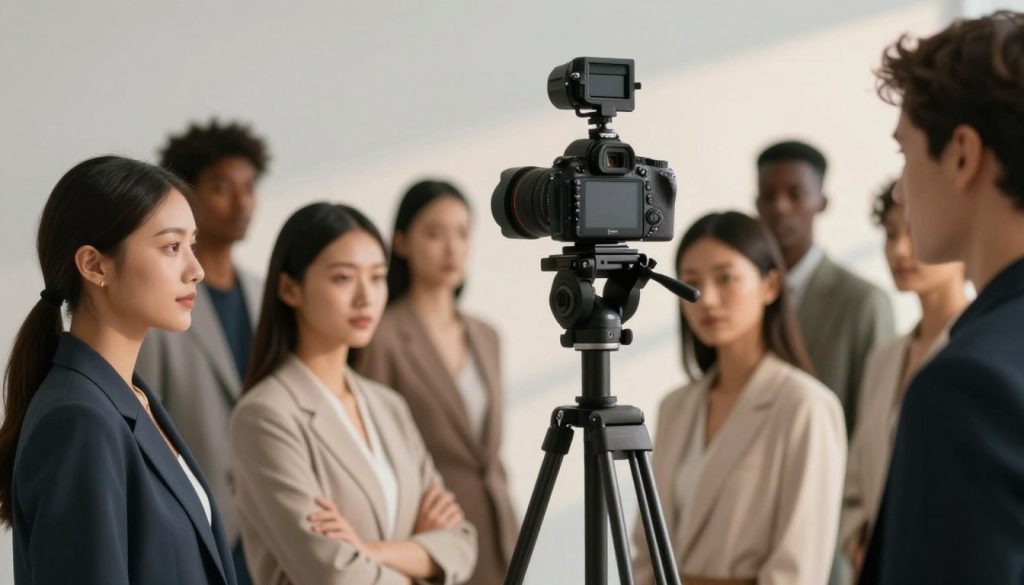
Getting light right is key for a photoreal ai porn mode that looks real. Lighting sets the mood, depth, and feel of your digital scenes. Think of your prompt as a detailed photography brief to control how light affects your subject.
Defining light sources and color temperatures
The color of your light changes the mood of your image. Use Kelvin values to pick the right tone, from warm and cozy to cool and sharp. Warm light brings a sense of closeness, while cool light gives a modern edge.
“Light is the most important tool in a photographer’s kit; it does not just illuminate the subject, it tells the story of the scene.”
Simulating studio lighting setups
To get a pro look, mimic studio lighting setups in your prompts. Real studios use controlled lights for specific effects. Describe where and how bright your virtual lights are.
Implementing softbox and rim lighting techniques
Softboxes soften light, making skin look better. Rim lighting adds a glow around the subject, making it pop. Together, they’re crucial for a top-notch photoreal ai porn mode look, highlighting body shapes.
- Softbox: Use for soft, even illumination across the skin.
- Rim Light: Place behind the subject to create a glowing outline.
- Key Light: Position at a 45-degree angle to add dimension.
Managing shadows and contrast ratios
Shadows add depth to your image. Make sure highlights don’t lose details. Proper shadow placement brings realism, often missing in AI images.
By balancing these, your photoreal ai porn mode scenes will look professional and cinematic. Try different light levels to find the perfect mix for your scene.
Refining skin detail and texture rendering
You can turn flat digital portraits into stunningly realistic images by mastering skin texture rendering. It’s not just about high resolution; it’s about understanding human biology. Using the right hd settings makes every pixel look natural and organic.
Applying skin texture LoRAs and embeddings
To improve your work, use specialized LoRAs (Low-Rank Adaptation) and textual embeddings for skin. These tools help focus on details like pores and freckles. Consistency is key when using these assets.
- Download high-quality skin texture LoRAs from reputable community hubs.
- Use negative embeddings to suppress unwanted digital artifacts.
- Adjust the weight of your LoRA to ensure it complements your base model without overpowering the facial structure.
Balancing pore visibility and smoothness
Finding the right balance between detailed pores and smooth skin is tricky. Too much detail can make the skin look gritty. Too little makes it lose character.
“True realism in digital portraiture is found in the subtle imperfections that define human skin, not in the absence of them.”
Strive for pores that are visible up close but soft enough to look natural from afar. Adjusting your denoising strength is key to achieving this balance.
Avoiding the plastic look in AI generations
The “plastic” look often comes from too much smoothing or bad lighting. Make sure your hd settings don’t just use high-contrast filters. Add color and texture variations to avoid uniform surfaces.
Enhancing subsurface scattering effects
Subsurface scattering makes skin glow softly by scattering light beneath the surface. Use prompts for “translucency” or “soft rim lighting” to achieve this. It adds depth and prevents skin from looking solid.
Optimizing sampling methods and step counts
Your choice of sampler and step count is key to creating high-quality images. These settings are the core hd settings that help your model turn noise into clear images. By adjusting these, you keep your images sharp and free from digital noise.
Selecting the best samplers for realism
Not all samplers work well for realistic textures. For top-notch results, try DPM++ 2M Karras or DPM++ SDE Karras. They balance speed with detail, perfect for skin and fabric.
If you like softer textures, Euler a is a good choice. But, avoid old samplers that can ruin your image. Test different samplers to find the best fit for your style.
Determining the ideal step count for convergence
The step count is how many times the model refines the image. More steps usually mean better quality, but too many waste time. Aim for 25 to 40 steps for most models.
Too few steps make textures blurry. Too many can make them too sharp or change colors. Finding the right balance in your hd settings keeps your images clear and efficient.
Managing CFG scale to prevent artifacting
The Classifier Free Guidance (CFG) scale controls how closely the model follows your prompt. Setting it too high can cause harsh contrasts and ugly colors. Stick to 5.0 to 8.0 for natural results.
Lowering the CFG scale by 0.5 can fix artifacts and color issues. This tweak is crucial for keeping colors accurate and lighting soft.
| Sampler Name | Best Use Case | Recommended Steps | CFG Range |
|---|---|---|---|
| DPM++ 2M Karras | General Photorealism | 25-30 | 5.0 – 7.0 |
| DPM++ SDE Karras | High Detail Textures | 30-40 | 6.0 – 8.0 |
| Euler a | Soft/Artistic Portraits | 20-30 | 5.0 – 7.0 |
| UniPC | Fast Iteration | 20-25 | 5.0 – 6.5 |
Advanced negative prompting for photorealistic results
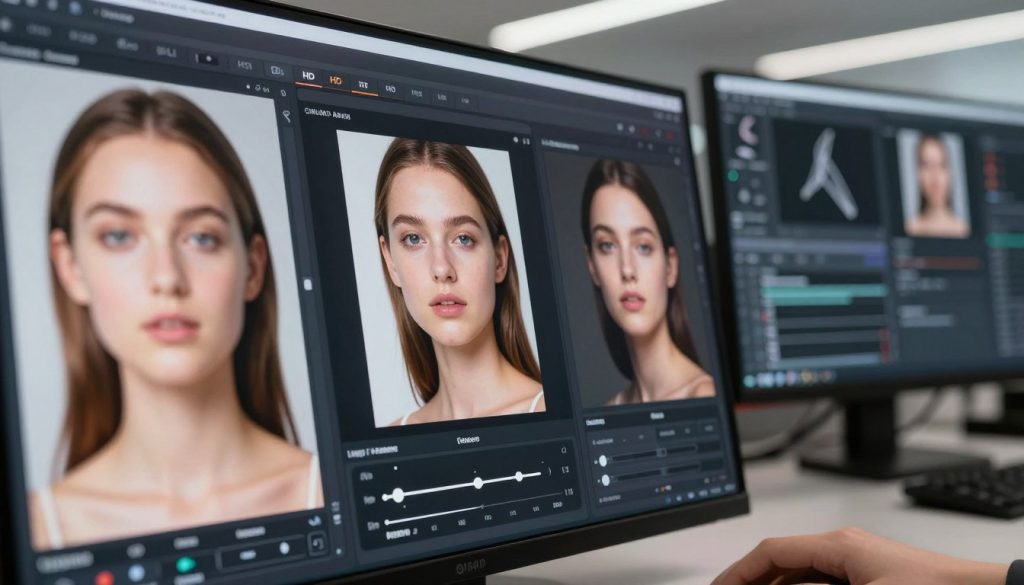
Negative prompting is a powerful tool that keeps your hd settings looking great. It tells the model what not to do, giving you more control. This way, your images stay real and avoid looking fake.
Filtering out digital artifacts and noise
Digital artifacts can make your images look bad. They include pixelated patches and unnatural colors. To fix this, use words like “low quality” and “jpeg artifacts” in your prompts.
By doing this, you clean up your images. It’s key for keeping your hd settings perfect during complex tasks. Regular cleaning helps avoid the noise that lower-quality images often have.
Removing cartoonish or illustrative styles
Many models tend to look too stylized. To get a more realistic look, avoid words like “cartoon” and “anime.” This helps the model focus on realistic textures and lighting.
Removing these styles makes your images look more like real photos. Here’s a table with some common negative keywords to keep your work professional.
| Category | Negative Keywords | Impact |
|---|---|---|
| Style | Cartoon, Anime, Sketch | Removes artistic bias |
| Quality | Blurry, Low-res, Artifacts | Enhances clarity |
| Lighting | Flat, Overexposed, Neon | Improves depth |
Standardizing negative prompt templates for consistency
Having a standard negative prompt template is best for quality. Save a list of negative terms that always work well. This keeps your hd settings consistent and high-quality.
Consistency is key for AI artists. Using a reliable template saves time and lets you focus on your creative vision.
Fine-tuning camera settings and lens simulation
Enhance your AI-generated images by mimicking a real camera’s precision. Treat your AI generation like a professional photoshoot. Use these hd settings to make your images look like they were shot in a high-end studio.
Simulating depth of field and bokeh
Depth of field makes your subject stand out against a soft background. Use prompts with wide apertures like f/1.8 or f/2.8 to focus on your subject. This creates a creamy bokeh effect, separating your subject from the background.
Setting these parameters adds visual hierarchy to your images. A shallow depth of field draws the viewer’s eye to the face. Include keywords like “bokeh” or “shallow depth of field” in your prompts for this effect.
Adjusting focal length for portrait realism
The focal length greatly affects how facial features appear. Use a lens simulation between 85mm and 135mm for natural and proportional results. These lengths provide a flattering compression, avoiding wide-angle distortion.
Shorter focal lengths can stretch the nose or forehead. Stick to these hd settings to keep your subject’s features intact. This detail is what makes your AI images look professional.
Applying film grain and color grading
Adding film grain and color grading can enhance your image. These elements remove the “digital” look, giving your work a cinematic, high-end aesthetic. A light film grain adds texture, while color grading unifies the tones.
| Lens Type | Focal Length | Best Use Case |
|---|---|---|
| Portrait Prime | 85mm | Classic headshots with soft bokeh |
| Telephoto | 135mm | Tight portraits with extreme compression |
| Standard | 50mm | Natural, eye-level environmental shots |
By balancing these camera simulations, you ensure your hd settings produce high-quality results. Experimenting with these variables helps you develop a unique style that stands out.
Troubleshooting common photorealism issues
Even with perfect hd settings, technical hurdles can disrupt your creative workflow. Modern AI models are powerful but sometimes produce unexpected results. Learning to identify and fix these errors is key to maintaining a professional standard in your work.
Correcting anatomical inconsistencies
Anatomical errors often appear when the model struggles with complex poses or overlapping limbs. Use ControlNet to guide the skeletal structure of your subject. If a limb looks distorted, adjust your prompt to emphasize the desired position or use an in-painting tool to regenerate the problematic area.
Fixing lighting bleed and color banding
Lighting bleed occurs when light sources spill into areas where they should not exist, creating a washed-out look. To fix this, refine your prompt to specify distinct light sources and their intensity. Color banding, visible steps in color gradients, often results from low-bit depth or aggressive compression. Increase your sampling steps or switch to a higher-quality VAE model to resolve this.
Resolving blurriness in high-resolution renders
Blurriness in high-resolution images often stems from improper upscaling or insufficient denoising strength. When applying your hd settings, ensure your upscaler is set to a sharp algorithm like R-ESRGAN 4x+. If the image remains soft, try lowering the denoising strength slightly to preserve the original structural integrity of the render.
| Issue Type | Primary Cause | Recommended Fix |
|---|---|---|
| Anatomical Error | Complex Pose | Use ControlNet |
| Color Banding | Low Bit Depth | Update VAE Model |
| Image Blur | Upscaler Mismatch | Adjust Denoising |
| Lighting Bleed | Prompt Conflict | Refine Light Tags |
Conclusion
To get professional results, you need to know your tools well and be patient. Now, you have the key to handle complex AI generation. This is through precise settings and crafting the right prompts.
Using these hd settings, you can make images that really pop. With regular practice, you’ll meet the high standards of top companies like Daz Productions Inc.
Improving means always trying new things and tweaking your approach. This way, you can create something truly unique. It also lets you explore what your models can do.
Focus on the small details that make things look real. The right hd settings help bring your vision to life. Don’t be afraid to share your work. It can help you see things from different angles and improve your skills.
FAQ
How do I properly activate and optimize the photoreal ai porn mode for my projects?
To use the photoreal ai porn mode well, start by picking a high-quality base model. This model should be trained on lots of real photos. Think of it like a professional artist choosing the best assets from Daz Productions, Inc. in West Jordan, UT.
Then, use high-definition settings in your interface. This lets the model handle detailed visuals without losing clarity.
What are the best hd settings for resolution and upscaling to ensure maximum realism?
For the best results, set your base dimensions to at least 512×768 or 768×1024. Use the Hires. fix tool with R-ESRGAN 4x+ to add details like eye highlights and skin pores. This makes the image look more real.
How can I simulate professional studio lighting through prompt engineering?
To get perfect lighting, clearly define your light sources. Use terms like “rembrandt lighting” and “softbox illumination” to add depth. This makes your images look like they were taken with top-notch equipment, like the Sony A7R IV.
What is the secret to refining skin detail and avoiding a “plastic” look?
For realistic skin, balance texture and smoothness. Use specific skin texture LoRAs at a strength of 0.4 to 0.7. This adds natural imperfections. Terms like “subsurface scattering” help the model capture how light interacts with skin, avoiding a fake look.
Which sampling methods and step counts are ideal for achieving photorealistic convergence?
For the best realism, use samplers like DPM++ 2M Karras or Euler a. Aim for 25 to 40 steps. Going over 50 steps can make the image too sharp and introduce digital noise.
How does negative prompting help in filtering out digital artifacts and illustrative styles?
Negative prompting is key for quality control. Tell the AI to avoid “cgi,” “3d render,” and “anime” to focus on photos. This helps remove unwanted digital effects and keeps the image realistic.
Can I simulate specific camera lenses and depth of field to enhance portrait realism?
Yes, you can set camera settings in your prompt. Use focal lengths like “85mm lens” for portraits. Add “shallow depth of field” and “creamy bokeh” to blur the background, just like a Canon EOS R5.
How do I troubleshoot common issues like anatomical inconsistencies or lighting bleed?
For anatomical issues, use ControlNet to lock poses or increase anatomical keyword weight. For lighting problems, lower the CFG scale slightly. This helps blend colors smoothly without harsh transitions.